
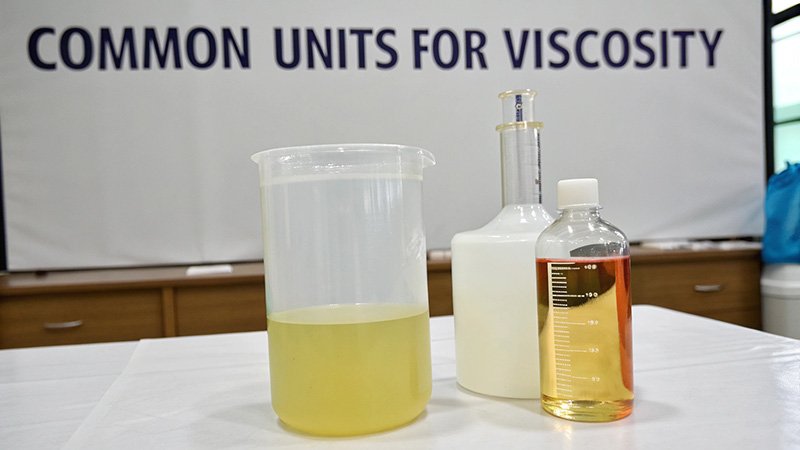
Confused by viscosity units like cP, mPa·s, and cSt? Using the wrong one leads to costly formulation errors and communication breakdowns with suppliers. Understanding these units is essential.
Dynamic viscosity is measured in Pascal-seconds (Pa·s) or centipoise (cP), where 1 mPa·s = 1 cP. Kinematic viscosity is measured in square meters per second (m²/s) or centistokes (cSt), where 1 mm²/s = 1 cSt. They describe different fluid properties.
I once worked with a purchasing manager, much like my client Jacky from Italy, who was sourcing a specific industrial oil. His supplier provided a spec sheet listing the viscosity in centistokes (cSt), but his lab's quality control team used one of our Martests rotational viscometers, which measures in centipoise (cP). He was stuck, unable to confirm if the supplied oil met their internal standards. This kind of confusion happens all the time. It highlights why a clear understanding of viscosity units is not just academic—it's a critical business need. Let's break this down step-by-step so you're never in that position.
What Are the Two Main Types of Viscosity?
Ever see "viscosity" used without specifying which type? This ambiguity causes confusion and can lead to incorrect instrument choice or test methods. Knowing the difference is the first step.
The two main types are dynamic (or absolute) viscosity and kinematic viscosity. Dynamic viscosity measures a fluid's internal resistance to flow under force, while kinematic viscosity measures this resistance relative to the fluid's density. They are not interchangeable.
Think of it this way. Dynamic viscosity is about the force needed to make a fluid move. Imagine pushing a wooden block across a table. The friction you feel is like the dynamic viscosity. It’s an internal property of the fluid itself. This is what our rotational viscometers at Martests directly measure. We apply a controlled force (torque) with a spindle and measure the fluid's resistance. In contrast, kinematic viscosity describes how a fluid flows under the influence of gravity. Imagine tipping the table and watching the block slide down on its own. How fast it slides depends on both friction and the block's weight (density). This is what instruments like capillary tubes or viscosity cups measure.
| Feature | Dynamic Viscosity | Kinematic Viscosity |
|---|---|---|
| What it Measures | Internal resistance to shear (force) | Resistance to flow under gravity |
| Role of Density | Independent of density | Directly dependent on density |
| Common Instrument | Rotational Viscometer | Capillary Viscometer, Viscosity Cup |
| Key Question | How much force to make it flow? | How fast will it flow on its own? |
What Are the Common Units for Kinematic Viscosity?
Seeing units like "Stokes" or "cSt" can be confusing. If you don't know what they mean, you can't compare product specs or understand test reports accurately. Let's clarify these units.
The standard SI unit for kinematic viscosity is square meters per second (m²/s). However, the most common units are Stokes (St) and centistokes (cSt). One Stokes equals 0.0001 m²/s, and 1 cSt equals 1 square millimeter per second (mm²/s).
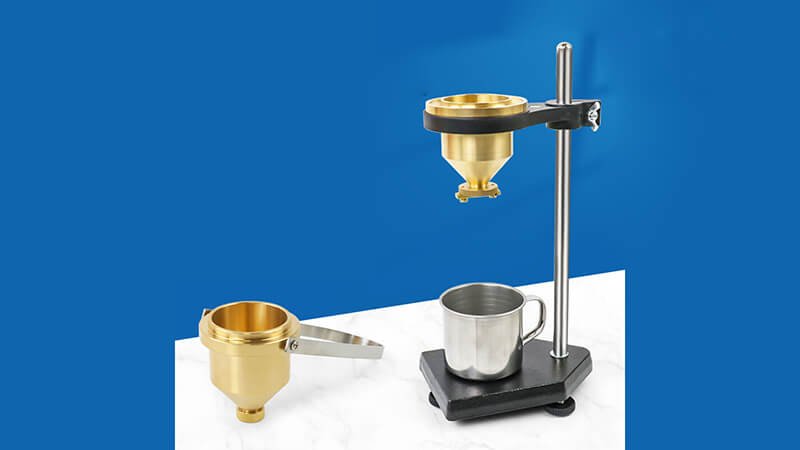
Kinematic viscosity is often measured by timing how long it takes for a set volume of fluid to flow through a small hole under gravity. The units reflect this relationship between area and time. The formal SI unit, m²/s, is very large and not practical for most industrial fluids. This is why the Stokes (St), named after physicist George Gabriel Stokes, became popular. But even a Stokes is a relatively large unit. In practice, almost everyone uses centistokes (cSt), which is one-hundredth of a Stokes. The unit mm²/s is identical to a cSt, and you will often see them used interchangeably on technical data sheets, especially in the petroleum and lubricant industries. A helpful reference is that the kinematic viscosity of water at 20°C is almost exactly 1 cSt.
| Unit | Equivalent in m²/s | Equivalent in cSt |
|---|---|---|
| 1 m²/s | 1 | 1,000,000 |
| 1 Stokes (St) | 0.0001 | 100 |
| 1 centistokes (cSt) | 0.000001 | 1 |
| 1 mm²/s | 0.000001 | 1 |
What Are the Common Units for Dynamic Viscosity?
Are you confused by Pa·s, mPa·s, and cP? This confusion can make comparing competitor data or setting quality control standards a real challenge. Here is a simple breakdown.
The SI unit for dynamic viscosity is the Pascal-second (Pa·s). More commonly used are the millipascal-second (mPa·s) and the centipoise (cP). These are convenient because 1 mPa·s is exactly equal to 1 cP, making them interchangeable.
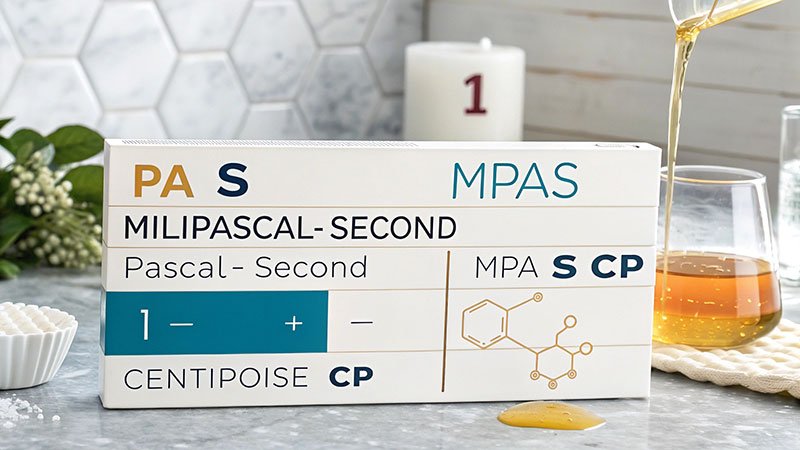
Dynamic viscosity is what most people in the coatings, food, and cosmetics industries are talking about. It’s the measurement of a fluid's "thickness" when a force is applied. The SI unit is the Pascal-second (Pa·s). However, just like with kinematic units, this base unit is too large for many common applications. As a result, the industry standardized on a much smaller and more convenient unit: the centipoise (cP). A "poise" is an older unit, but the "centipoise" (one-hundredth of a poise) has remained the global standard. The great thing is that it corresponds perfectly with the modern SI-derived unit, the millipascal-second (mPa·s). The simple rule is 1 cP = 1 mPa·s. This makes conversion effortless. Our Martests rotational viscometers typically display results in cP or mPa·s, which is what our customers need for their quality control.
| Substance (at ~20°C) | Approximate Dynamic Viscosity |
|---|---|
| Water | 1 cP |
| Milk | 3 cP |
| Honey | 10,000 cP |
| Ketchup | 50,000 cP |
How Are Dynamic and Kinematic Viscosity Related?
Do you need to convert between dynamic and kinematic viscosity? Without the right formula, you can't compare data from different test methods, which can halt product development. There is a simple formula.
Dynamic and kinematic viscosity are related by the fluid's density. To convert between them, use the formula: Kinematic Viscosity = Dynamic Viscosity / Density. You must know the fluid's density at the same temperature as the viscosity measurement.
This simple relationship is the key to solving the problem my client faced. The bridge between the two types of viscosity is the fluid's density (mass per unit volume). The formula is often written as:
ν = η / ρ
Here:
ν(nu) is the kinematic viscosity.η(eta) is the dynamic viscosity.ρ(rho) is the density.
For this formula to work, you must use consistent units. The most practical version for everyday lab work is:
Kinematic Viscosity (in cSt) = Dynamic Viscosity (in cP) / Density (in g/cm³)
Let's use a real example. A customer measures a syrup with one of our rotational viscometers and gets a reading of 400 cP. They know from their records that the syrup's density is 1.25 g/cm³ at the test temperature. To find the kinematic viscosity, they calculate:
Kinematic Viscosity = 400 cP / 1.25 g/cm³ = 320 cSt
This allows them to directly compare their result with a supplier's technical data sheet that lists the spec in cSt.
Conclusion
Mastering viscosity units like cP and cSt is key. Understanding their relationship and proper use ensures accurate measurement, clear communication, and superior quality control for your products.