
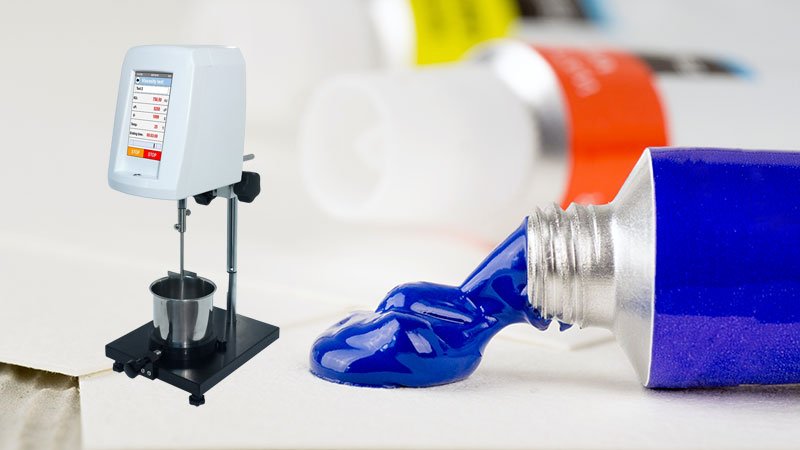
Struggling with paint consistency? Inconsistent batches can lead to customer complaints and wasted product. The Stormer viscometer provides the standard measurement you need for reliable quality control.
A Stormer viscometer measures a fluid's consistency by determining the force needed to rotate a paddle-shaped spindle at 200 RPM. It is the industry standard for paints and coatings, providing results in Krebs Units (KU) for fast and easy quality control.
I've seen many clients in the paint industry rely on this specific instrument. It has a unique way of working that's perfectly suited for their products. Many purchasing managers, like my friend Jacky in Italy, trust it because it gives them a simple, reliable number that everyone in the industry understands. It's a specialized tool, so let's break down exactly how it operates and why it's so trusted.
What is the Principle of Measurement for a Stormer Viscometer?
Unsure how Stormer viscometers get their readings? This uncertainty can make you doubt your quality control data. Understanding its simple, resistance-based principle builds confidence in your results.
A Stormer viscometer uses a paddle-type spindle submerged in the sample. A motor drives the spindle at a fixed speed of 200 RPM. The instrument measures the internal resistance (torque) required and displays this as a Krebs Unit (KU) value.
The basic idea behind this viscometer is simple and practical. It was originally designed to mimic the action of stirring paint in a can. Older manual models used a falling weight system. The operator would add weights to a pulley until the paddle spindle rotated at exactly 200 RPM. The amount of weight in grams gave the measurement. Today, modern digital Stormer viscometers automate this entire process. A precision motor rotates the spindle at a constant 200 RPM. An internal sensor measures the torque, or resistance, the motor needs to overcome. The instrument’s electronics then instantly convert this torque reading into Krebs Units (KU), grams (g), and centipoise (cP) on a digital screen. This removes the guesswork and manual labor, making the test much faster and more repeatable for busy QC labs.
What is the Design and Structure of a Stormer Viscometer?
Looking at a new instrument can seem complicated. Not knowing its components makes operation and troubleshooting difficult. Let's identify the main parts and their simple functions.
The key components are the paddle-shaped spindle, a sample container holder, a fixed-speed motor, a torque sensor, and a digital display. These parts work together to automate the viscosity measurement and ensure repeatable results.
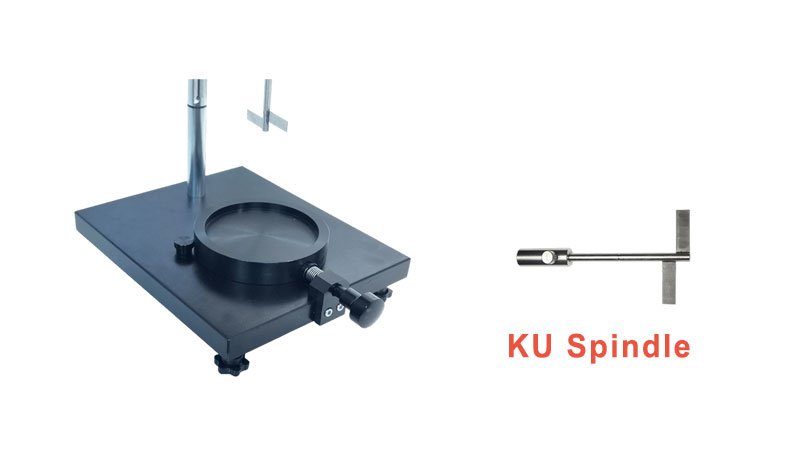
When you use a Stormer viscometer, you are interacting with just a few key parts. Each one has a specific job.
Paddle (or rotor)
This is the most recognizable part. It’s a special paddle-shaped spindle designed specifically for this test method (ASTM D562). It rotates inside the sample to sense the fluid's resistance.
Sample container
The instrument base has a platform designed to hold a standard-sized sample can, usually a 1-pint or 1-quart can. This ensures the sample is always in the correct position.
Motor system
A precision motor drives the paddle. Its most important feature is that it maintains a constant rotational speed of exactly 200 revolutions per minute (RPM) during the test.
Torque-sensing mechanism
This is the "brain" of the modern instrument. It’s an electronic sensor that measures how much force (torque) the motor needs to use to keep the paddle spinning at 200 RPM in the fluid.
Readout scale
On modern digital models, this is a clear LCD screen that displays the measurement results directly in KU, grams, and/or cP.
What Do the Measurement Units Mean?
Do you find the different units on a Stormer viscometer confusing? Reporting the wrong unit can cause major confusion with suppliers or customers. Let's clarify what each unit represents.
Krebs Units (KU) are the unique, primary scale for paint consistency. Grams (g) represent the original load measurement. Centipoise (cP) is a calculated viscosity value. KU is the most common unit in the paints and coatings industry.
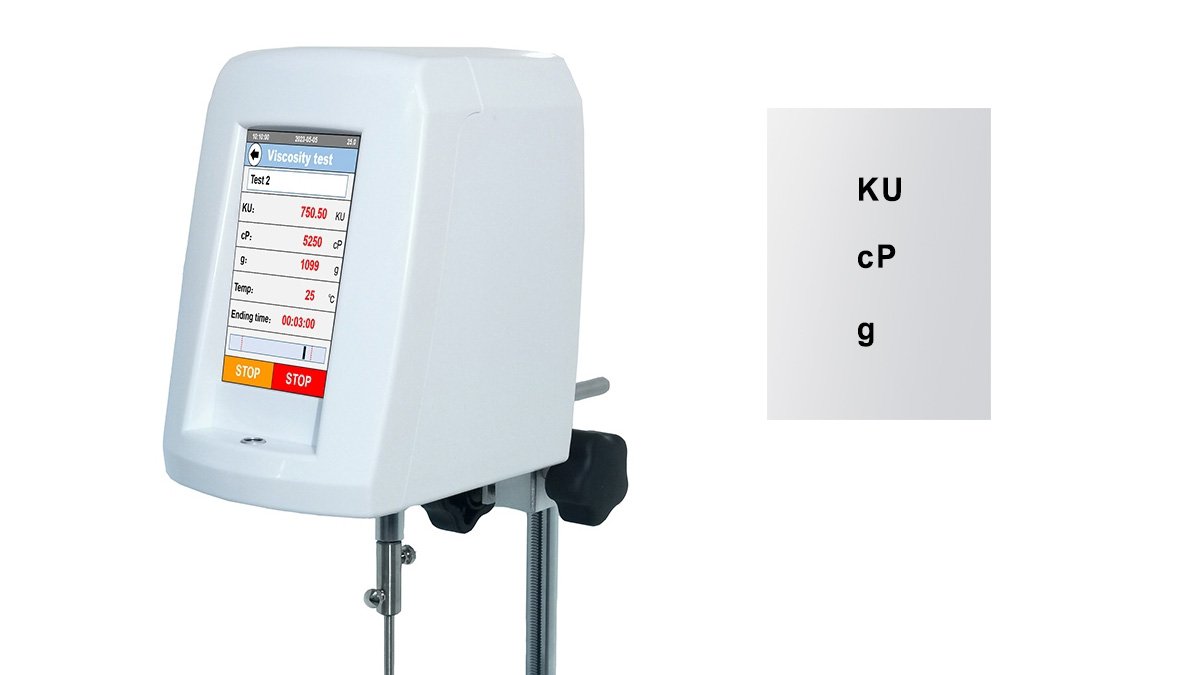
Most digital Stormer viscometers can display results in three different units. Understanding each one helps you communicate your results effectively.
Krebs Units (KU)
This is the most important unit. The KU scale is an empirical, non-linear scale created specifically for the paint industry. It typically ranges from about 40 to 141 KU. When a paint specification sheet says "Viscosity: 95-105 KU," this is the instrument they are using.
Grams (g)
This unit goes back to the original manual Stormer viscometers. It represents the load in grams that was required to rotate the paddle at 200 RPM. Digital models calculate this value from the torque reading.
Centipoise (cP)
This is a standard unit of dynamic viscosity. The Stormer viscometer calculates an apparent viscosity in cP based on the KU value. It's useful for comparison, but remember, KU is the true standard for this test method.
| Unit | Description | Primary Use |
|---|---|---|
| Krebs Units (KU) | An empirical, non-linear scale from ~40 to 141. | Industry standard for paints and coatings. |
| Grams (g) | The load required to rotate the paddle at 200 RPM. | The fundamental measurement of resistance. |
| Centipoise (cP) | A calculated dynamic viscosity value. | General comparison and internal R&D. |
Where Are the Applications for a Stormer Viscometer?
Not sure if a Stormer viscometer is the right instrument for your product? Choosing the wrong tool means wasted time and inaccurate data. Let's review its primary applications.
The Stormer viscometer is essential in the paints and coatings industry for quality control. It is also used for adhesives, sealants, and printing inks where consistency at a specific shear rate is critical.
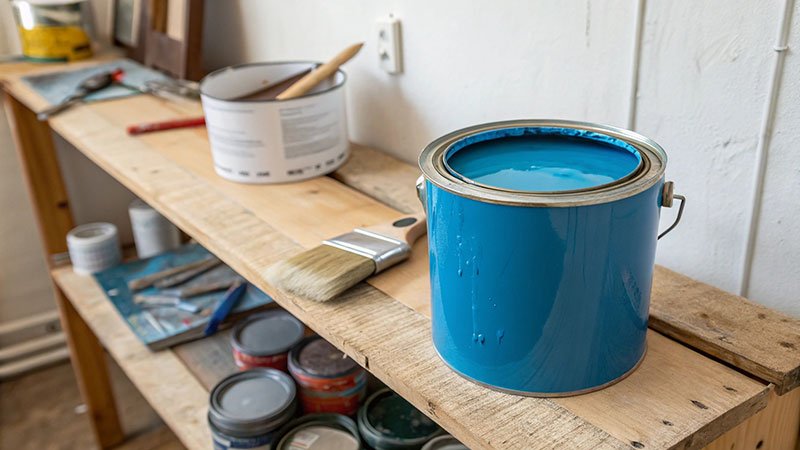
This viscometer is a specialist tool. You will find it in any industry where the "body" or consistency of a medium-viscosity fluid is critical for its performance.
Paints and coatings industry
This is the number one application. The Stormer viscometer is used to enforce the ASTM D562 standard. Manufacturers use it to ensure that every batch of a specific paint has the same consistency. This guarantees it will brush, roll, or spray correctly for the end-user.
Adhesives and sealants
For many glues, mastics, and sealants, the KU value is a quick and effective way to check production consistency. It ensures the product is not too thin or too thick to apply properly.
Printing inks
The consistency of printing inks is vital for how they flow and transfer on a printing press. A Stormer viscometer provides a reliable QC check.
Quality control labs
In general, any QC lab that deals with these types of materials will have a Stormer viscometer. It's a workhorse instrument for quick and reliable pass/fail testing.
What Are the Advantages of a Stormer Viscometer?
Deciding on a viscometer is a big investment. You need to be sure it will deliver the reliable results your business needs. The Stormer viscometer has several key advantages.
Its main advantages are its status as the industry standard for paints (ASTM D562), its simple operation requiring minimal training, and its ability to provide highly consistent and reproducible results for quality control.
For the right application, a Stormer viscometer is often the best choice. I have a customer who owns a paint factory, and for him, this instrument is non-negotiable. Its value comes down to three main points.
Industry-standard for paints
This is its greatest strength. The method is defined by ASTM D562. When you report a KU value, everyone in the supply chain—from raw material suppliers to the final customer—knows exactly what it means. It creates a common language for quality.
Simple to operate
Modern digital models are incredibly easy to use: place the can, lower the head, and press "start." This simplicity reduces the chance of operator error and cuts down on training time. It is perfect for a busy factory floor or QC lab.
Consistent and reproducible
The test is highly controlled. The speed is fixed at 200 RPM, and the spindle is a standard shape. This means the results are very repeatable. For quality control, this is the most important feature. You can trust that a change in the reading means a change in the product, not a problem with the test.
What Are the Limitations of a Stormer Viscometer?
Thinking the Stormer viscometer can do everything? Using it for the wrong task, like deep rheological research, will lead to incomplete data and frustration. Understanding its limitations is key.
The Stormer is not a full rheometer; it cannot measure viscosity at different speeds. Its range is limited to medium-viscosity materials, and its primary unit, KU, is specific to certain industries.
As with any specialized tool, the Stormer viscometer is not the right choice for every job. It's important to know what it can't do.
Not a full rheometer
This is the most important limitation. It tests at only one speed (200 RPM). It cannot tell you about complex flow behaviors like thixotropy (how a fluid thins when stirred and thickens at rest) or yield stress. For detailed product development and R&D, you need a multi-speed rotational viscometer or rheometer.
Limited range
The instrument is designed specifically for materials in the viscosity range of typical paints and coatings. It is not suitable for very thin liquids like water or solvents, nor is it good for extremely thick pastes or putties.
Unit specificity
The Krebs Unit is the standard for paints, but it means very little to someone working in the food, cosmetic, or petroleum industry. It is a specialized instrument, and its greatest strength—its industry focus—is also its main limitation.
Conclusion
The Stormer viscometer is an essential, easy-to-use tool for quality control in the paint and coatings industry. It ensures your product consistency meets required standards every single time.