
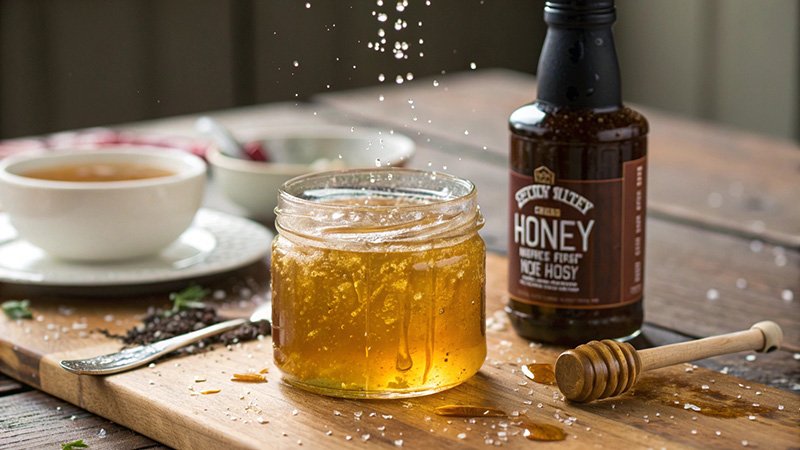
Your food product has an inconsistent texture, and customers are complaining. This is because standard tests don't work for every food. Understanding viscosity measurement is the key to ensuring quality.
Viscosity measurement is critical in the food industry because it controls texture, mouthfeel, stability, and processability. It ensures a consistent product, from the thick, slow flow of honey to the perfect cling of a sauce, directly impacting consumer satisfaction and brand loyalty.
I've learned from working with many food producers that the biggest challenge is matching the test method to the specific food. A distributor of mine, Jacky, once had a client whose sauce was perfect in the factory but watery on the customer's plate. The problem wasn't the recipe; it was their testing method. It gave them a single number that didn't tell the whole story. Different foods, like honey, sauces, and creams, behave differently. Getting the measurement right is vital for product consistency and keeping consumers happy. Let's break down how to do this correctly.
Why is viscosity so important for food products?
You think viscosity is just about "thickness." This limited view leads to poor quality control and inconsistent products. In reality, viscosity affects mouthfeel, stability, and even how you produce it.
Viscosity is crucial for the consumer experience (mouthfeel, cling) and production efficiency (pumpability, filling). It provides an objective number to ensure a consistent, high-quality product from batch to batch, satisfying both the consumer and the production line manager.
Viscosity goes far beyond a simple "thick" or "thin" description. It is a critical parameter that impacts a food product at every stage, from production to the moment a customer eats it. For the consumer, viscosity defines the sensory experience. Think about the difference between a rich, creamy yogurt and a thin, watery one. That difference is viscosity. It also determines how a dressing clings to a salad or how a glaze sits perfectly on a pastry. In the factory, viscosity dictates processability. Can a thick paste be pumped through pipes without damaging the equipment? Can jars be filled quickly and accurately without stringing or splashing? The answers lie in viscosity data. By measuring and controlling it, you turn a subjective quality like "texture" into a hard number, which is essential for modern quality control.
How Viscosity Impacts Food Quality
| Aspect | Impact of Viscosity | Example |
|---|---|---|
| Mouthfeel | Defines the perceived texture, richness, and creaminess. | Thick, high-viscosity yogurt feels luxurious. |
| Appearance | Controls how a product coats, drips, or holds its shape. | A glaze with the right viscosity evenly coats a donut. |
| Stability | Prevents ingredients from separating over time. | Salad dressing with proper viscosity won't separate. |
| Processability | Determines ease of pumping, mixing, and filling. | A low-viscosity sauce is easier to pump and bottle. |
How do you measure the viscosity of thick products like honey?
You try to measure thick, sticky honey, but your readings are inconsistent. You might be getting useless data or even damaging your viscometer. Using the right spindle and technique is the solution.
For thick products like honey or paste, use a rotational viscometer with a T-bar spindle. Run the test at a very low speed and use a Helipath stand, which moves the spindle to ensure it's always measuring a fresh part of the sample.
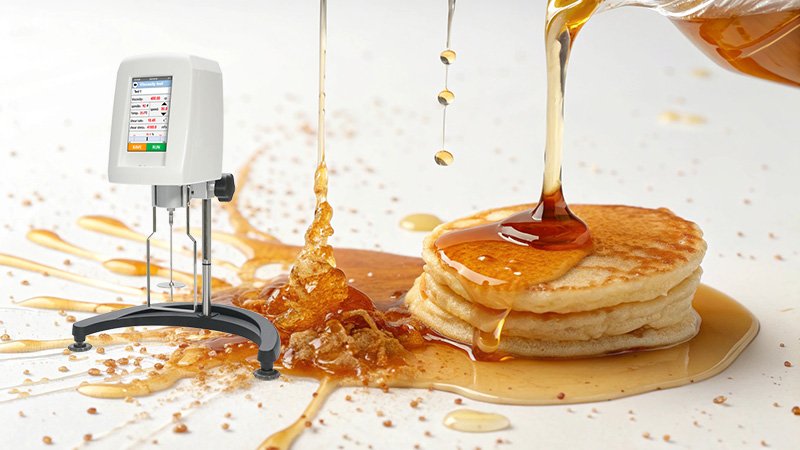
Thick, non-flowing materials like honey, cream cheese, or pastes present a unique challenge. If you use a standard spindle, it can create a hole or channel within the sample as it rotates. The spindle ends up spinning in a pocket of air or separated liquid, giving you a falsely low and meaningless viscosity reading. This is a common problem I help customers solve. The solution is a special accessory called a Helipath stand. The Helipath slowly moves the viscometer's measuring head up and down. This drives the T-bar spindle in a helical path through the sample. By constantly moving, the spindle is always encountering fresh, undisturbed material, which gives a true and repeatable measurement of the material's consistency. This setup is the industry standard for testing non-flowing or paste-like foods and is something I always recommend to clients like honey producers.
The Right Setup for Thick Foods
| Parameter | Recommendation for Honey/Pastes | Why? |
|---|---|---|
| Spindle Type | T-Bar Spindle | It is designed to cut into the material, not just push it away. |
| Speed (RPM) | Low (e.g., 0.5 - 5 RPM) | Prevents the "channeling effect" and torque overload errors. |
| Accessory | Helipath Stand | Ensures the spindle is always in contact with a fresh sample. |
What's the best way to test the viscosity of sauces and dressings?
Your sauce is perfect in the mixing tank but thin and watery on the plate. Your simple, single-point viscosity test is missing key information. You need to test for shear-thinning behavior.
Sauces and dressings are often shear-thinning. Test their viscosity at multiple shear rates using a rotational viscometer. This helps you understand how they flow when poured (high shear) versus how they sit on food (low shear).
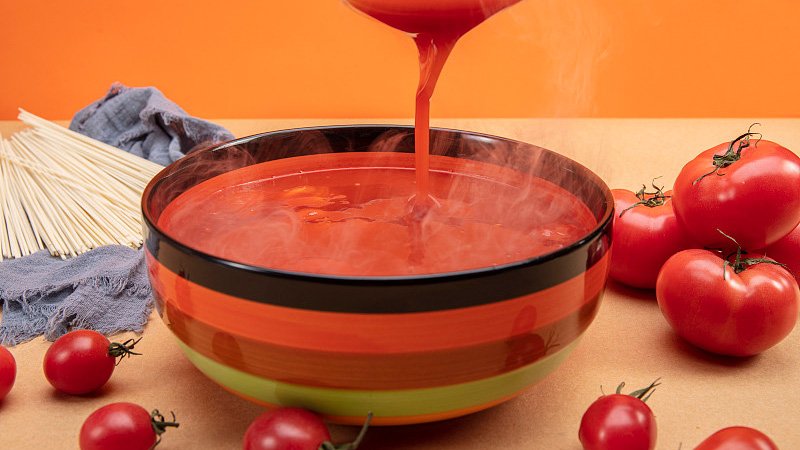
Many sauces, dressings, and condiments are non-Newtonian fluids. Specifically, they are "shear-thinning." This means their viscosity changes with stress. The classic example is ketchup. It is thick in the bottle (high viscosity at low shear). When you shake or squeeze the bottle, you apply stress (high shear), and it thins out and flows easily. Once it's on your food, the stress is gone (low shear), and it becomes thick again. A single viscosity measurement cannot capture this behavior. You need to create a "flow curve." You do this by measuring the viscosity at several different rotational speeds (RPMs). This tells you the full story of how your product will behave for the consumer. My insight about aligning the test with the texture is critical here. For sauces, a multi-speed test is the only way to ensure a good customer experience.
Testing for Shear-Thinning Behavior
| Action | Shear Rate | Desired Viscosity | Test Speed (RPM) |
|---|---|---|---|
| At rest in bottle | Low | High (to prevent separation) | Low (e.g., 1 RPM) |
| Pouring/Squeezing | High | Low (to flow easily) | High (e.g., 100 RPM) |
| On the food | Low | High (to cling and not run off) | Low (e.g., 1 RPM) |
Can a viscometer help with quality control for dairy and beverages?
Your yogurt or milk drink feels different from one batch to the next. Customers notice this inconsistency and may lose trust in your brand. A viscometer provides the objective data needed for reliable QC.
Yes, a viscometer provides objective data for the mouthfeel of dairy and beverages. For low-viscosity items like milk, use a cup and bob system or a UL adapter for precision. For yogurt, a standard rotational viscometer works well.
In the dairy and beverage industry, "mouthfeel" is a key selling point. A viscometer turns this subjective feeling into an objective, repeatable number for quality control. However, different products require different tools. For very thin liquids like milk, juice, or nutritional drinks, the viscosity is very low. A standard spindle may not be sensitive enough to detect small but important batch-to-batch variations. For these applications, I recommend a specialized system like a Cup and Bob viscometer. These systems have a very precise, defined geometry that is ideal for accurately measuring low-viscosity fluids. For thicker products like yogurt, sour cream, or puddings, a standard rotating spindle viscometer is perfect. You can establish a target viscosity range. If a batch falls within this range, it passes QC. This removes the guesswork from sensory panels and ensures every container of your product has the same creamy texture your customers expect.
Choosing the Right System for Dairy
| Product Type | Challenge | Recommended System | Why? |
|---|---|---|---|
| Milk, Juice, Drinks | Very low viscosity requires high sensitivity. | Cup and Bob or UL Adapter | Provides the high precision needed for thin liquids. |
| Yogurt, Cream, Pudding | Mouthfeel and texture consistency. | Standard Rotational Viscometer | Easily quantifies texture for routine pass/fail QC. |
How does temperature affect food viscosity measurements?
Your viscosity readings for the same product are all over the place. You are wasting time re-testing, not realizing the room temperature is the real problem. The solution is simple: always control the sample temperature.
Temperature has a huge impact on viscosity; a change of just 1°C can significantly alter results. For accurate, repeatable measurements, always use a temperature-controlled water bath or a viscometer with integrated temperature control.
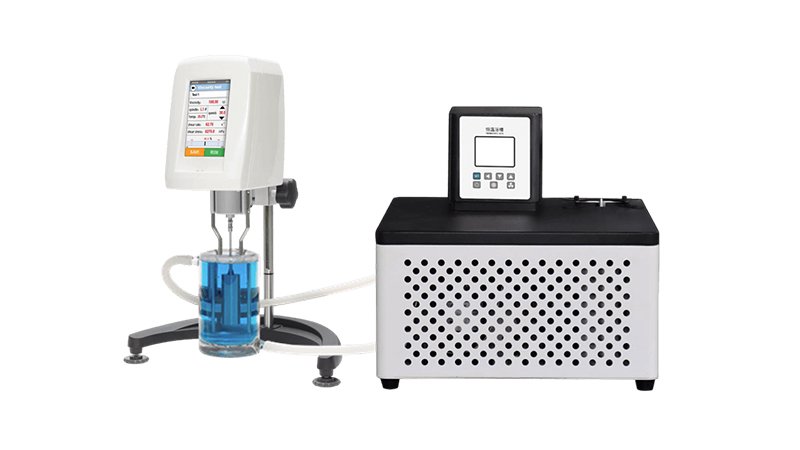
Viscosity is highly dependent on temperature. For nearly all food products, when temperature goes up, viscosity goes down. Think about chocolate or butter; they are solid when cool and liquid when warm. This principle applies to all liquids, even if the effect is less dramatic. I once helped a client whose chocolate sauce viscosity was lower in the afternoon than in the morning. We discovered the lab's air conditioning was less effective in the afternoon sun, raising the ambient temperature by a few degrees. That small change was enough to throw off their QC results. The solution is to control the temperature during every test. The most common way is to place the sample beaker in a circulating water bath set to a precise temperature, such as 25.0 °C. This ensures that every test, whether done in the morning or afternoon, in winter or summer, is performed under the exact same conditions for reliable, comparable results.
Temperature's Effect on Viscosity
| Temperature Change | Effect on Viscosity (most foods) | The Professional Solution |
|---|---|---|
| Increase (↑) | Viscosity Decreases (↓) | Use a water bath or Peltier controller. |
| Decrease (↓) | Viscosity Increases (↑) | Standardize and record the test temperature for every measurement. |
Conclusion
To master food quality, match your test method to the food type and always control the temperature. This ensures accurate viscosity data, consistent products, and happy, loyal customers.