
Your coating doesn't spread right, or your ink forms bad droplets. You suspect viscosity is the problem, but the real issue might involve its hidden partner: surface tension.
Surface tension and viscosity are not directly related but are connected by intermolecular forces. Viscosity is a fluid's resistance to flow (a bulk property), while surface tension is the force holding its surface together (a surface property).
I get this question a lot. A customer in the coatings industry, someone like Jacky from Italy, will tell me, "Stefan, the viscosity of my paint is perfect according to my Martests viscometer, but it's not leveling properly. It looks uneven." This is a classic case where looking only at viscosity misses half the story. The way a liquid behaves in its bulk is different from how it behaves at its surface. Let's explore this important connection.
How can we understand the fundamentals of fluid behavior?
You measure fluid properties but don't grasp the core concepts. This leads to confusion when lab results do not match real-world performance, costing you time and materials.
Viscosity is a fluid's internal friction, its resistance to flow. Surface tension is the cohesive energy at a fluid's surface that makes it act like a thin, elastic sheet. Both are crucial.
To control a fluid, you must first understand its basic properties. Think of them as two different personalities of the same liquid. One describes how it moves, and the other describes how it holds itself together at the edges.
What is viscosity?
Viscosity is simply a measure of a fluid's thickness or its resistance to flowing. Honey has a high viscosity; it flows slowly. Water has a low viscosity; it flows easily. My company, Martests, builds rotational viscometers that measure this property accurately. For simple fluids like water (Newtonian fluids), viscosity is constant. But for complex fluids like paint or ketchup (non-Newtonian fluids), viscosity changes when you apply force. This is a bulk property, meaning it describes the entire body of the fluid.
What is surface tension?
Surface tension is a surface property. The molecules inside a liquid are pulled equally in all directions by their neighbors. But at the surface, molecules are only pulled inwards and sideways. This inward pull creates a tight, elastic-like film on the surface. It's why water can form beads on a leaf and why some insects can walk on water. It is a measure of the energy required to increase the surface area of a liquid.
What is the scientific relationship between surface tension and viscosity?
You assume high viscosity means high surface tension. This wrong assumption leads to bad formulation choices and failed products, which wastes your R&D resources.
There is no direct rule connecting them. Both depend on intermolecular forces, but they describe different physical phenomena. A fluid can have high viscosity and low surface tension, or vice versa.
This is one of the biggest misconceptions I see. It seems logical that a "thicker" fluid would also hold together more tightly at its surface, but science shows us this is not always true.
Intermolecular Forces are the Connection
Both properties come from the forces between molecules (intermolecular forces). Stronger forces, like hydrogen bonds in water, can lead to higher values for both properties. As you increase temperature, molecules move faster and the forces between them weaken. This is why heating a liquid usually lowers both its viscosity and its surface tension. However, the structure of the molecules and how they interact is complex. Long, tangled polymer chains can create high viscosity without creating high surface tension.
Debunking the Correlation Myth
Let's look at some examples to make this clear.
| Fluid | Viscosity (Relative) | Surface Tension (Relative) | Direct Correlation? |
|---|---|---|---|
| Water | Low | High | No |
| Honey | Very High | Medium | No |
| Mercury | Low | Very High | No |
| Ethanol | Low | Low | No |
As you can see, there is no simple pattern. Mercury is not very viscous, but it has one of the highest surface tensions. It forms tight little balls. Honey is extremely viscous, but its surface tension is much lower than mercury's. You cannot predict one property just by knowing the other. You must measure both.
Where do both surface tension and viscosity matter in the real world?
Your products are failing in application. Your paint will not level, your cream separates, or your ink will not print, and you cannot find the cause.
Both properties are critical in coatings, food, cosmetics, and printing. Viscosity controls flow and thickness, while surface tension governs spreading, droplet formation, and the stability of emulsions or foams. A balance is key.

The balance between these two properties determines whether a product works or fails. In my business, I see this every day across many industries that we export to, from Europe to South America.
Coatings and Paints
When you apply paint, its viscosity must be low enough to flow out of the can and be brushed easily, but high enough to stay on the wall without sagging. That's the job of viscosity. But surface tension determines if the paint will "wet" the surface and spread out into a smooth, level film. If the surface tension is too high, the paint can pull back on itself, causing defects like "craters" or "crawling."
Food and Cosmetics
Think about a salad dressing. It's an emulsion of oil and water. Viscosity gives it a thick, rich texture that clings to lettuce. Surface tension is what happens at the boundary between each tiny oil droplet and the water around it. If the surface tension is not managed correctly with emulsifiers, the oil and water will separate over time. The same principle applies to cosmetic lotions and creams, where texture and stability are everything.
Inkjet Printing
This is a perfect example of a delicate balance. The ink's viscosity must be very low to be jetted through tiny nozzles without clogging. But its surface tension must be just right to form a clean, spherical droplet after it leaves the nozzle. If it's too low, the ink may ooze. If it's too high, the droplet won't form correctly.
How can you measure viscosity and surface tension accurately?
You get inconsistent measurements for viscosity and surface tension. This unreliable data makes it impossible to control your product quality or troubleshoot formulation problems effectively.
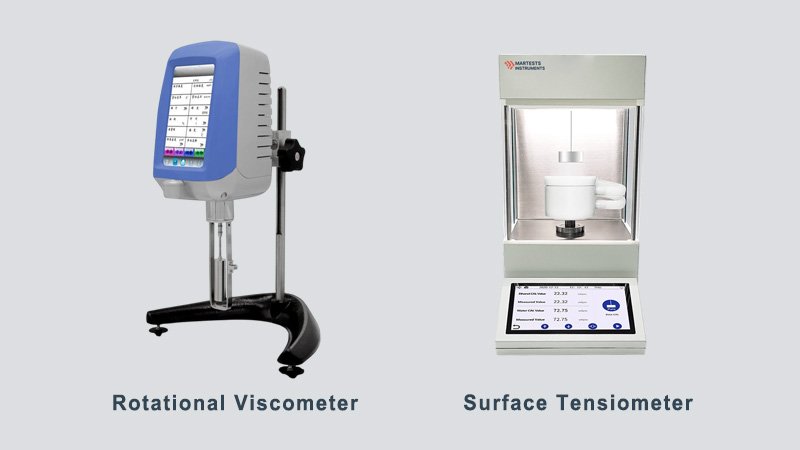
Use a rotational viscometer, like the ones from Martests, for viscosity. For surface tension, use methods like the du Noüy ring or Wilhelmy plate. Control temperature and keep samples clean for accurate results.
Getting good data is the first step to solving any problem. Bad data is worse than no data because it leads you in the wrong direction. Accuracy and repeatability are essential.
Measuring Viscosity
For measuring viscosity, a rotational viscometer is the standard instrument in most industries. At my factory in China, we produce high-quality viscometers that are reliable and easy to use. They work by rotating a spindle in the fluid and measuring the torque required. This gives a precise viscosity value. For our B2B clients, who are often distributors, providing a top-quality, customizable instrument is our main focus.
Measuring Surface Tension
Surface tension is measured with a tensiometer. Common methods include the du Noüy ring and the Wilhelmy plate. Both work by measuring the force needed to pull a precisely shaped object (a ring or a plate) from the liquid's surface. This force is directly related to the surface tension.
The Importance of Controlled Conditions
For both measurements, temperature is the single most important factor to control. A change of even one degree can significantly alter your results. It is also critical to ensure your samples and equipment are perfectly clean. Any contamination, especially for surface tension, can ruin the measurement because impurities tend to collect at the surface.
How do these two properties influence final product performance?
You struggle to optimize your product. Adjusting one ingredient fixes one problem but creates another, leaving you stuck in a cycle of trial and error.
Balancing viscosity and surface tension is key to performance. This balance affects how a product is processed (mixing, spraying) and how it behaves for the end-user (texture, appearance, stability).
Understanding the theory is good, but applying it to improve your product is what really matters. This is where you turn data into profit.
Formulation Optimization
Product formulation is all about finding the perfect balance. You might add a solvent to lower the viscosity of a coating, but that solvent could also change the surface tension. You might add a surfactant to lower surface tension for better wetting, but this can sometimes create foam or alter the final texture. Knowing how each ingredient affects both properties allows formulators to make smart choices instead of just guessing. It reduces development time and leads to better products.
Processability and Behavior
The balance also affects how your product behaves in your factory. For a spraying process, the fluid must atomize into fine droplets, which requires a specific combination of viscosity and surface tension. For a filling process, the liquid must flow quickly into bottles without splashing or creating foam. By measuring and controlling these properties, you can make your production lines run faster and with less waste. This is a direct benefit to the bottom line for any manufacturer.
Conclusion
Viscosity and surface tension are different but linked by molecular forces. Mastering both is essential for creating high-quality, reliable products and achieving excellent performance in any application.